
 1-877-206-4279

Nursing programs do not set upper age limits, state boards do not set them for licensure, and employers hiring new graduates are hiring for competence. Nor is the profession quietly hoping you will not apply. Look at how the workforce actually replenishes: the Bureau of Labor Statistics projects roughly 189,100 registered nurse openings each year through 2034.
Nursing Schools Turned Away 93,176 Qualified Applicants Last Year. Here Is What to Do If One of Them Was You.

The American Association of Colleges of Nursing publishes an annual count of qualified applications turned away. In data released in May 2026, that figure reached 93,176 for the 2025-2026 academic year, the highest ever recorded. Two years earlier it was around 63,000. That is roughly thirty thousand additional rejections in a single biennium.
Where Can Phlebotomy Take You? From First Draw to Medical Assistant or Medical Lab Technician
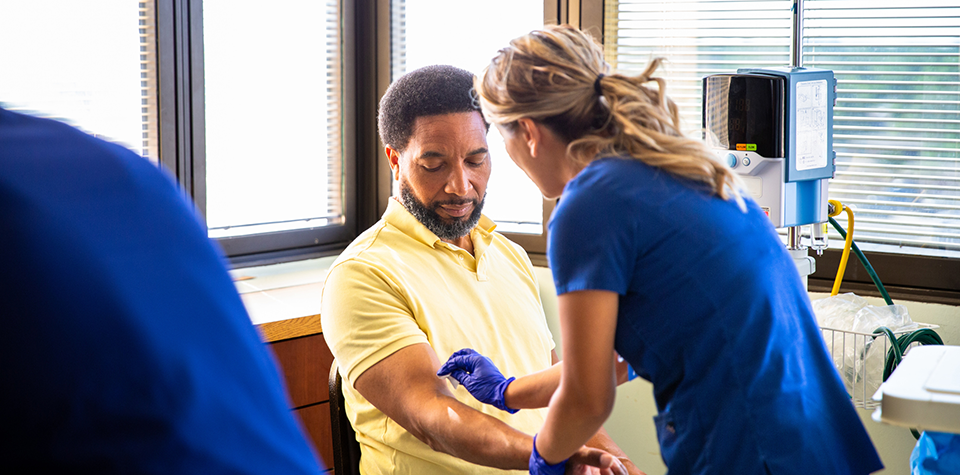
Why an 11-week phlebotomy credential is one of the most practical first steps in healthcare and how Cambridge mentors help you turn it into a Medical Assistant or Medical Laboratory Technician career.
Miami’s Real Nursing Shortage Isn’t the One You’ve Heard About

The Florida Center for Nursing’s Florida Health Care Workforce Projections 2022-2037 found that registered nurse supply growth is on track to closely match demand, holding statewide RN adequacy near 93% by 2037. The RN pipeline is improving. Schools expanded, enrollment rose, and the profession is producing nurses at a rate the state has not managed in years.
Cambridge College of Healthcare & Technology’s Delray Beach Campus Trains Nurses on a Hospital Campus with ACEN-Accredited Nursing at the Center

Located in a Class A building on the Delray Medical Center campus, Cambridge pairs hospital-adjacent clinical placement with an ACEN-accredited Associate of Science in Nursing program and a credential ladder that reaches the nurse practitioner level.
The TEAS Is 170 Questions in 209 Minutes. Here Is How to Walk In Ready.

The Test of Essential Academic Skills is the pre-admission assessment most U.S. nursing programs use to judge whether an applicant has the academic foundation to survive a clinical curriculum. The current version is TEAS 7. It does not test nursing. It tests whether you can read carefully under time pressure, do arithmetic and algebra without panicking, remember enough biology and chemistry to build on, and write in standard English.
From Nursing Assistant to Nurse Practitioner: What the Ladder Looks Like When Someone Actually Climbs the Whole Thing

If you have spent any time researching nursing programs, you have read the generic success story: an unnamed student, a stock photograph, an arc with no friction in it. It proves nothing, because it describes no one. The reader knows this, which is why it does not work.
The Skill Nobody Puts on a Syllabus: Emotional Intelligence in Healthcare and Tech

Emotional intelligence (EQ) is the ability to recognize what you are feeling, manage it, read what other people are feeling, and use that information to respond well. In healthcare and technology, it is not a soft extra, it is a clinical and professional tool.
Healthcare AI Is Accelerating in the Lab. Who Gets It to the Bedside?

The “last mile” of healthcare AI is the distance between a proven tool and its everyday use in a real care setting. It gets closed by the people who run the systems: nurses, health information professionals, medical coders, informaticists, cybersecurity staff, and administrators. It does not get closed by the people who invent the tools.